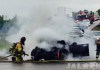
Tesla CEO Elon Musk has taken to the company blog today to talk about a Tesla Model S fire that caught the attention of the news media this week. Musk says that the fire was caused by a piece of a tractor trailer which punctured the battery compartment of the car with a ‘peak force on the oder of 25 tons’.
The owner of the car, says Musk, was able to pull off of the road safely and exit the car. The fire began in the front module was ‘contained to the front section of the car’, Musk says, and never entered the passenger compartment.
“Earlier this week, a Model S travelling [sic] at highway speed struck a large metal object, causing significant damage to the vehicle,” Musk said. “The geometry of the object caused a powerful lever action as it went under the car, punching upward and impaling the Model S with a peak force on the order of 25 tons. Only a force of this magnitude would be strong enough to punch a 3 inch diameter hole through the quarter inch armor plate protecting the base of the vehicle.”
Musk was also careful to point out statistics that show that gas vehicles are just as susceptible, if not more-so, to a similar kind of impact. “Had a conventional gasoline car encountered the same object on the highway, the result could have been far worse,” the Musk letter says. “A typical gasoline car only has a thin metal sheet protecting the underbody, leaving it vulnerable to destruction of the fuel supply lines or fuel tank, which causes a pool of gasoline to form and often burn the entire car to the ground.”
Musk quotes statistics that he says point to the fact that you are 5 times more likely to experience a fire in a gas-powered car than a Tesla. Musk notes that a gas tank is typically only protected by a thin sheet of metal, not the 1/4″ ‘armor plate’ that’s featured in Teslas. Musk also trots out numbers — a move reminiscent of his mostly successful campaign against a negative NY Times review — related to car fire safety. Over 150,000 car fires per year, 1 vehicle for every 20 million miles and 1 fire in over 100 million miles driven for Teslas equate to the ’5x’ figure that Musk notes.
At this point it’s probably important to note that Tesla has only been around for a few years, while conventional gas vehicles have had a lot more ‘miles driven’ to have an opportunity to catch on fire. Still, the track record of the company with regards to road safety and fires does pull a stark contrast.
This is in obvious response to the media attention the fire got, and the fact that some of the stock pullback that Tesla has experienced in the last few days was attributed to a ‘viral’ video shot of the fire on a Washington highway. That pullback was likely more about convertible notes and a downgrade by Baird, but the timing of the fire has to be seen as brutal by Tesla PR and company watchers.
The full letter is below:
Earlier this week, a Model S travelling [sic] at highway speed struck a large metal object, causing significant damage to the vehicle. A curved section that fell off a semi-trailer was recovered from the roadway near where the accident occurred and, according to the road crew that was on the scene, appears to be the culprit. The geometry of the object caused a powerful lever action as it went under the car, punching upward and impaling the Model S with a peak force on the order of 25 tons. Only a force of this magnitude would be strong enough to punch a 3 inch diameter hole through the quarter inch armor plate protecting the base of the vehicle.
The Model S owner was nonetheless able to exit the highway as instructed by the onboard alert system, bring the car to a stop and depart the vehicle without injury. A fire caused by the impact began in the front battery module – the battery pack has a total of 16 modules – but was contained to the front section of the car by internal firewalls within the pack. Vents built into the battery pack directed the flames down towards the road and away from the vehicle.
When the fire department arrived, they observed standard procedure, which was to gain access to the source of the fire by puncturing holes in the top of the battery’s protective metal plate and applying water. For the Model S lithium-ion battery, it was correct to apply water (vs. dry chemical extinguisher), but not to puncture the metal firewall, as the newly created holes allowed the flames to then vent upwards into the front trunk section of the Model S. Nonetheless, a combination of water followed by dry chemical extinguisher quickly brought the fire to an end.
It is important to note that the fire in the battery was contained to a small section near the front by the internal firewalls built into the pack structure. At no point did fire enter the passenger compartment.
Had a conventional gasoline car encountered the same object on the highway, the result could have been far worse. A typical gasoline car only has a thin metal sheet protecting the underbody, leaving it vulnerable to destruction of the fuel supply lines or fuel tank, which causes a pool of gasoline to form and often burn the entire car to the ground. In contrast, the combustion energy of our battery pack is only about 10% of the energy contained in a gasoline tank and is divided into 16 modules with firewalls in between. As a consequence, the effective combustion potential is only about 1% that of the fuel in a comparable gasoline sedan.
The nationwide driving statistics make this very clear: there are 150,000 car fires per year according to the National Fire Protection Association, and Americans drive about 3 trillion miles per year according to the Department of Transportation. That equates to 1 vehicle fire for every 20 million miles driven, compared to 1 fire in over 100 million miles for Tesla. This means you are 5 times more likely to experience a fire in a conventional gasoline car than a Tesla!
For consumers concerned about fire risk, there should be absolutely zero doubt that it is safer to power a car with a battery than a large tank of highly flammable liquid.
Developing…
Image via Jalopnik


